The pattern #187
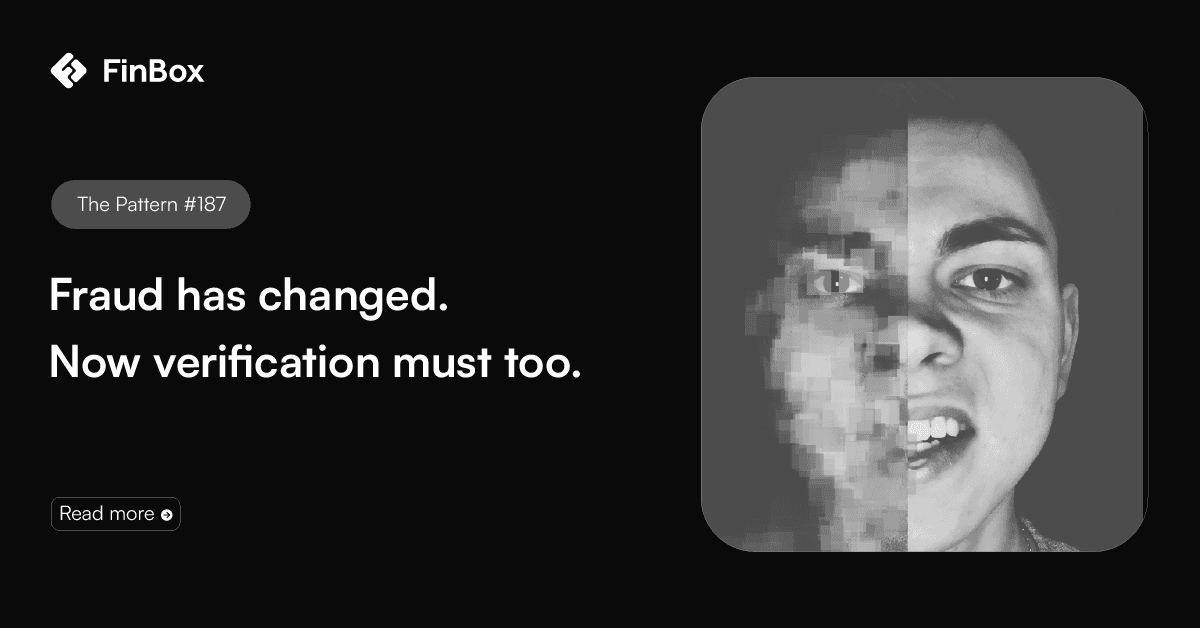
Fraud has changed. Now verification must too.

Mayank Jain
Head - Marketing and Content
·
Hello everyone,
Welcome to the 187th edition of The Pattern.Let’s get into what’s shaping finance, technology, and the economy this week.
What’s striking is that the number of incidents hasn’t grown at the same pace as the money lost. And that tells us something important: fraud today isn’t about small, random attempts anymore. It’s about fewer but far more damaging attacks. And that usually means organisation, automation, and scale.
From one-off scams to coordinated attacks
Over the last few years, fraud has shifted in three clear ways:
Scale: breached data and automation are being used to create large volumes of believable borrower profiles.
Sophistication: synthetic identities, credit washing, and bust-out patterns are showing up more often.
New entry points: BNPL, app onboarding, and even voice and SMS flows are now part of the attack surface.
This is no longer about a masked hacker slipping through the cracks. It’s coordinated activity that probes systems, learns what passes, and then scales what works.
This is where things get harder for lenders in 2026.
Fraud is no longer a one-time verification problem
Most lending stacks still treat verification as a moment in time: check identity, approve or reject, move on.
But modern fraud doesn’t behave like that. A borrower can look fine at onboarding and still become risky later, across accounts, across products, across lenders.
That means verification can’t stay at a single gate at the start of the journey.
It has to become an ongoing, connected risk process that adapts as behaviour and patterns change. And this is where many lenders fumble.
Why operational control now matters as much as detection
Today’s verification setups are often stitched together from multiple vendors, manual reviews, and engineering-dependent workflows. When fraud patterns shift, risk teams raise tickets. Policy updates wait for development cycles. By the time changes go live, attackers have already moved on.
In an environment where fraud adapts quickly, slow response becomes part of the risk itself.
This is exactly the gap that Superflows is designed to address -- not by adding another point solution, but by turning verification into a policy-driven, automated workflow that risk teams can control directly.
Instead of managing KYC, KYB, income checks, and fraud signals across disconnected tools, Superflows brings them into a single verification layer. Risk teams can configure how checks run, when they escalate, and how journeys adapt, without waiting on engineering or vendor cycles.
That ability to change verification logic as fast as fraud evolves is what will be crucial in 2026.
The real risk frontier: Connected verification, not taller gates
Looking ahead, five capabilities will increasingly separate resilient lenders from reactive ones:
Multi-source detection and real-time triage
Identity orchestration across vendors and journeys
Shared intelligence across customers and products
Strong monitoring and containment when things slip through
Clean, reliable data pipelines that don’t break at scale
What matters isn’t how many checks you run, but whether your verification setup can change when fraud patterns do.
Why this is important going forward
Digital lending in India will keep scaling in 2026. Journeys will keep getting faster. Products will keep launching. But fraud will keep evolving too.
The next phase of lending won’t be won by who approves fastest alone, but by who can verify smarter, respond quicker, and adapt policies without friction.
In modern lending, trust isn’t decided at onboarding. It’s managed continuously, across the entire borrower journey.
Reading list
Rupee slides as tariff woes, outflows blunt impact of RBI intervention
India’s Digital Payments Hit 2025 Peak in Dec, Driven by UPI and FASTag
Budget 2026: MSMEs Seek Faster Payments, Cheaper Credit & Lighter Compliance
Why India’s Banking Fraud Amounts Rose Despite Fewer Incidents
That’s all for this week. See you next time!
If you liked this edition, please forward it to friends, colleagues, and your network. Do encourage them to subscribe as well. You can also follow FinBox on LinkedIn and myself on X to keep up with all the updates.
Cheers,
Mayank
